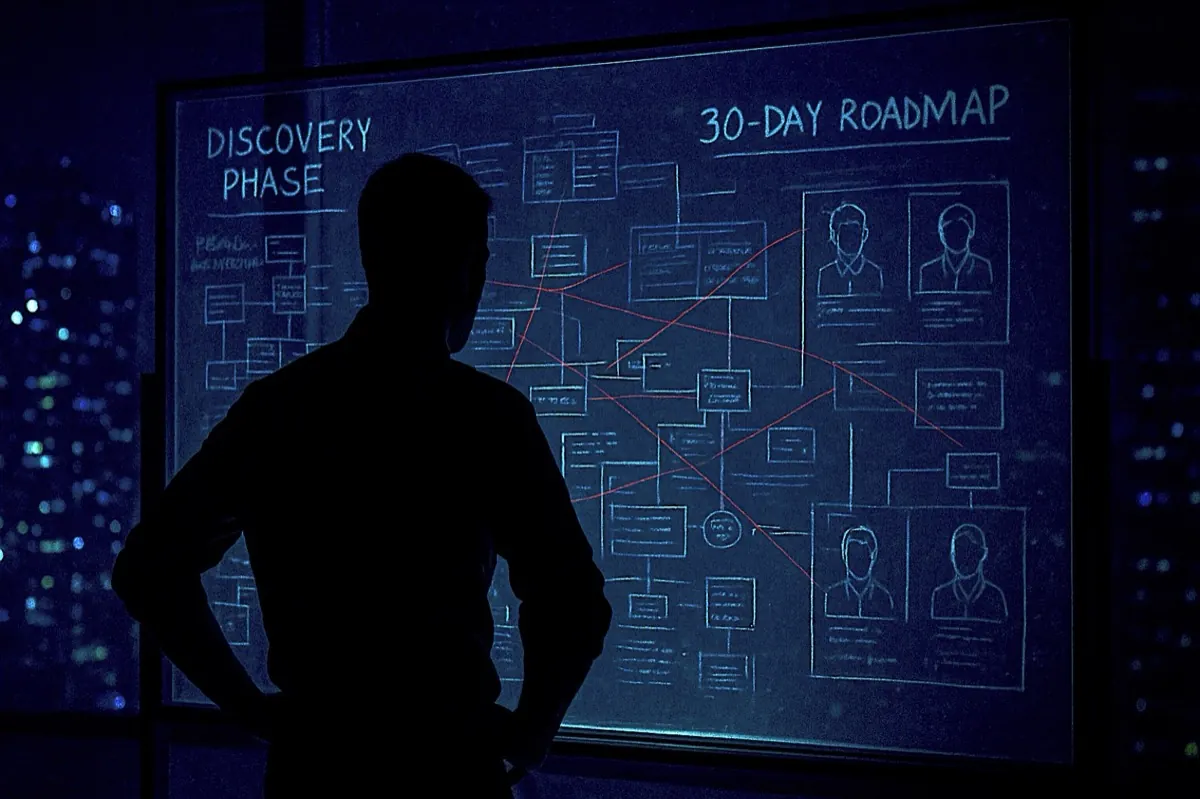
You’ve landed that dream gig, VP, CIO, CPO.
But then Day One hits, and the reality sinks in.
That sleek office or conference room feels like a throne at first, but then the meetings roll: a sprawling org with teams pulling you in every direction, names blurring together, and subtle red flags waving. Projects are hit or miss, there’s interpersonal friction, and perhaps another team is already sniffing around your territory.
Your CEO pings at the end of the day: “How’s it going? Thrilled you’re here.”
You fire back “All good!” with a knot in your stomach, wondering if you’ll make it.
I remember the early days, specifically a role where I was hired as a Lead System Administrator. Day One came with zero onboarding documentation, two managers, and total chaos. I had to build a system from the ground up just to survive.
That specific struggle was the motivation for this guide.
Enter The Algorithm for Onboarding
I know that feeling well.
I have over a decade in SaaS and leadership stints across Aerospace, Defense, Education, and Retail, I’ve stepped into ad-hoc roles like VP of Engineering and CTO more times than I’d like to count. Currently, I’m guiding Site Reliability Engineers, Database Administrators, and Full Stack Devs-staying hands-on enough to unblock them without diving into every commit.
These transitions never get easier, but they have taught me a repeatable playbook for the first 30 days. It has evolved from trial and error into something well-refined and actionable, especially as tools like AI sharpen how we lead and observe.
Here is the playbook carrying me into 2026.
The Mental Reset (Impostor Syndrome)
Take a deep breath. Every leader I’ve mentored or shadowed has stared down this exact fog. The psychological overhead is real: the org feels massive, names don’t stick, and that CEO check-in triggers a survival scan.
This is the entry fee for senior seats; impostor syndrome hits hard because the stakes do.
Trust the skills that got you hired, remember, you’re here for a reason.
Data Collection (Discovery Mode)
For the first two weeks, operate in “read-only" mode. Clear the calendar of any execution tasks and pack it with 1:1s, including quiet observation in team huddles. Listen way more than you speak.
Run a simple script in every meeting:
- Unpack their role: How does it fit the org’s architecture?
- Surface the signal: What are three features firing on all cylinders?
- Identify the noise: What are three bugs or blockers grinding things down?
- Get a pointer: Ask for two key people outside your current view (even cross-org) that you should speak to next.
Post-meeting, document it all. This isn’t passive note-taking; it’s engineering a mental map of the org’s real topology, not just the static org chart.
Pattern Recognition and Mapping
Themes emerge fast from your data collection. Project A might be technical debt masquerading as progress; Person B could be an MVP talent stuck in junior packaging.
By week two, disect it: three critical fixes to patch, three strengths to accelerate. This isn’t just intel; it’s the raw signal for future info flow, cutting through noise before biases harden.
Refactoring the Team
Week three often spotlights the “legacy debt” in your lineup. Sometimes this is process, but sometimes it is personnel.
If a personnel refactor screams for it (role shift or exit), execute early. You’ve got a fresh slate right now; dragging it out to month eight morphs a clean patch into legacy bloat. It feels brutal-you’re still onboarding, and context is sparse-but the org is usually primed for it, and inaction benchmarks your standards low.
Stakeholder Alignment
Lock in these three levels immediately:
- Direct reports: They are your daily multipliers. Grab dinners or coffees to see them beyond the role spec.
- Peers: Build lateral bridges early to dodge silos later.
- The Boss: This is your non-negotiable anchor.
Check in relentlessly. Share observations, calibrate against theirs, and nail down “success” vectors. Aim for an every-few-days cadence; misalignment here is the root cause of most executive crashes.
The “MVP” Win
Credibility demands a proof-of-concept fast. Scout a crisis or stalled sprint, a site outage, PR glitch, or jammed deal and dive in.
This isn’t micromanaging; it’s showcasing your debug style and your value-add. It flips the script from “org-chart layer” to “sleeves rolled up contributor,” proving you’re wired for impact, not just oversight.
Async Communication
Weekly, drop an update to the full org: Who’s on your radar from 1:1s, high-level patterns spotted, plus a slice of your own path.
Consistency is the killer feature (same slot, same channel, same skeleton). Writing scales you like nothing else; it demystifies your day and pulls the team into a loop they rarely see
The 30-Day Retrospective
At month-end, compile your discovery data into a baseline doc: Observed topology, emergent themes, and next-quarter opportunities.
Broadcasting this transparently? Uncomfortable as hell most execs aren’t built for raw mirrors. But it shines truth back at the org from a neutral fork, sparking shifts that stick.
I’ve seen these artifacts act as north stars years later, measuring progress against the original scan.
These steps might scan as basics, but their power lies in repetition. They scale across tech, sales, and ops. These gigs will test you, but remember: you earned the shot for a reason.
Experiment, iterate, and execute.
How have you engineered your own onboarding to debug the early chaos?